Atomic Design: Elevating UX Through Modular Design
In the dynamic world of web and application design, staying organised while maintaining a consistent and visually appealing user experience is paramount. This is where the Atomic Design methodology comes into play, offering a systematic approach that fosters design consistency, efficiency, and scalability. In this article, we’ll delve into what Atomic Design is, its key principles, and its significant relevance to creating exceptional digital products.
Atomic Design is a methodology introduced by Brad Frost in 2013. It takes inspiration from chemistry by breaking down design systems or a user interface (UI) into its smallest, reusable components, akin to atoms in the periodic table. These atoms are the smallest, indivisible components of a design, such as buttons, input fields, icons, and typography styles. These atoms are then combined to create molecules (groups of atoms working together), organisms (combinations of molecules), templates (arrangements of organisms), and eventually, full-fledged pages or screens.
The five distinct levels in Atomic Design are:
- Atoms: These are the basic UI elements like buttons, text fields, and checkboxes that cannot be broken down any further without losing their meaning.
- Molecules: Molecules are combinations of atoms, forming a functional unit like search bars, input groups, or navigation menus.
- Organisms: Organisms are more complex components made up of molecules and atoms, such as header sections, card components, or sidebars.
- Templates: Templates provide a layout structure for arranging organisms on a page, defining the overall page structure without the specific content.
- Pages: Pages are instances of templates filled with actual content, representing the final product that users interact with.
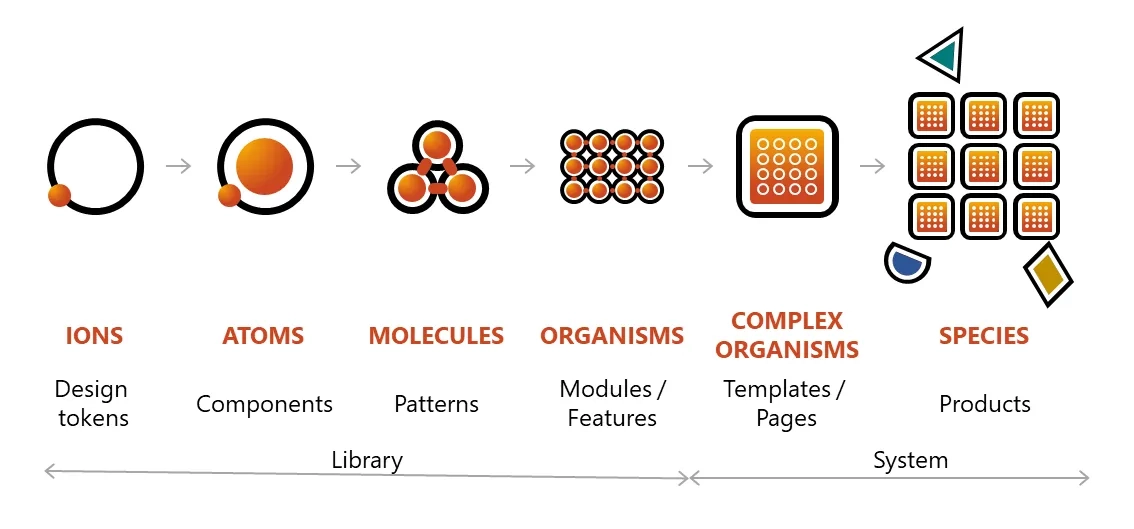
The five levels of Atomic Design make digital products more consistent, scalable, and efficient.
Atomic Design methodology is based on a set of principles that guide the creation of modular and scalable user interfaces. These principles help designers and developers build cohesive and consistent design systems. The core principles of Atomic Design include:
Hierarchy: Atomic Design emphasises a hierarchical structure for UI components. Starting from the smallest building blocks (atoms) and progressing to more complex structures (organisms, templates, and pages), this hierarchy ensures a logical organization of components that can be combined to create entire user interfaces.
Modularity: Atomic Design encourages designers to create components that are self-contained and reusable. This modular approach saves time, as designers can reuse atoms and molecules across various parts of a project.
Consistency: By adhering to a set of predefined atoms and molecules, designers can maintain visual and functional consistency throughout the design system. This consistency enhances the user experience, as users become familiar with the interface elements.
Reusability: Atomic Design encourages the creation of components that can be reused across different parts of a design system. By developing a library of atoms and molecules, designers and developers can consistently apply these components throughout various interfaces, ensuring a consistent user experience.
Scalability: As projects grow in complexity, the Atomic Design methodology allows for easy scalability. New components can be built by assembling existing atoms, molecules, and organisms, leading to efficient design system expansion.
Collaboration: Atomic Design promotes collaboration between designers, developers, and other stakeholders. With a shared library of design components, cross-functional teams can work cohesively, reducing misunderstandings and speeding up the development process.
Clarity of Purpose: Each level in the Atomic Design hierarchy serves a distinct purpose. Atoms define basic UI elements, molecules combine atoms to create functional components, organisms compose molecules to form recognisable sections, templates establish layout structures, and pages present content within those structures. This clear division of purpose helps designers and developers make informed decisions about how to structure their components.
Benefits to User Experience
Atomic Design has profound implications for enhancing user experience design:
- Consistent Design Language: By establishing a library of atomic components, designers ensure a consistent design language across an application or website. This consistency leads to a smoother user journey, as users recognise and understand familiar UI elements.
- Faster Prototyping and Development: With a repository of reusable components, designers can rapidly prototype interfaces, speeding up the design iteration process. Developers can also implement these components more efficiently, reducing development time.
- Responsive Design: Atomic Design naturally aligns with responsive design principles. Since atoms, molecules, and organisms are designed to be modular, they can be rearranged and resized to adapt to different screen sizes and devices seamlessly.
- User-Centred Approach: Atomic Design’s emphasis on modularity and consistency allows designers to focus on crafting components that best serve the user’s needs. This user-centred approach ultimately results in interfaces that are intuitive and easy to navigate.
- Easier Maintenance: When updates or changes are needed, Atomic Design simplifies the process. By modifying a single component, changes ripple across all instances where that component is used, ensuring uniformity.
In the realm of user experience design, Atomic Design methodology stands as a robust framework that empowers designers to create coherent, scalable, and user-friendly interfaces. Its emphasis on breaking down designs into smaller, reusable components not only streamlines the design and development process but also enhances the overall user experience. As technology continues to evolve, embracing Atomic Design can be a strategic move for delivering exceptional user experiences in a consistent and efficient manner.