Augmented Reality in UX
One sunny afternoon, I decided to buy a wireless speaker. I browsed for some speakers online using my mobile phone. And as I was checking a particular product, I noticed an option on their shopping app saying, “Try to fit this in your room”. I was wondering how could that be possible. Are they going to deliver the speaker here in my place just to see if it fits on my favourite table? Or are they going to instruct me on how to measure the dimensions of my allocated space and match it with the product? Curious, I decided to click the said link and I was amazed by what I saw. My camera turned on, with my product superimposed on the screen. I was able to move and rotate it with a few swipes, and the product glows green when it is placed on a flat surface with adequate space. I was simply astounded!
That technology is called “Augmented Reality” (or “AR” in short). One of the world’s most successful business and technology influencer, Bernard Marr, defined AR as a method of overlaying digital images on to the real world to enhance them with digital details while responding to real-world inputs. This piece of technology is gaining popularity nowadays. We can see it on well-known social media platforms such as TikTok and Snapchat as a camera filter, giving entertaining and aesthetic effect to your images and videos in real time. It is also being utilised in businesses, one good example is the Dulux Visualizer where the app allows you to choose a paint color and let you see the colours live in your living space to help you choose the best color for your walls.

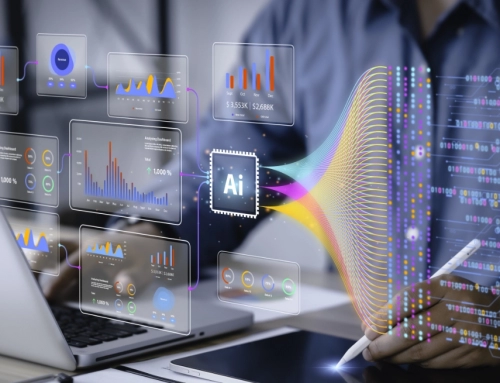
AR-powered user interface displaying data collected from various sources.
User interfaces utilising Augmented Reality are considered non-command interface in which the tasks are done with the help of contextual information gathered by the machine and/or computer system instead of commands coming directly from the user. The computer system then “augments” the reality and interprets the collected context by running a process in the background that analyses the external inputs and respond to them, and /or provide useful information. AR-powered user interfaces provide great opportunities for enhancing the user experience (UX). According to the Nielsen Norman Group website, AR can help the UX in 3 fundamental ways:
- By decreasing the interaction cost to perform a task The lack commands in AR interfaces makes the interaction efficient and requires little user effort: AR systems are proactive and take the appropriate action whenever the outside context requires it.
- By reducing the user’s cognitive load With an AR system, the useful part information is displayed automatically, and the user does not need to spend effort to “save” it on paper or elsewhere. Thus, AR UIs decreases working-memory load in two ways:Like any non-command UI, they do not require users to learn commands.They allow users to move information smoothly from one context to another.
- By combining multiple sources of information & minimising attention switches With AR, the multiple sources of information can be combined by displaying relevant information coming from different sources in an overlay on top of the main interface, so the user won’t need to divide attention. Many complex tasks (e.g., surgery, writing a report) do involve putting together multiple sources of information; some of them will benefit from AR.
While the AR’s value still has a lot of room for improvement from a mainstream consumers’ point of view, its enterprise usage in manufacturing, food, healthcare and many other industries are already showing bright future in terms of functionality. To me, the value of Augmented Reality is already reaching the standards in product design and development. I can truly say that the future of AR is promising, and it will continue to improve and evolve in the years to come.